
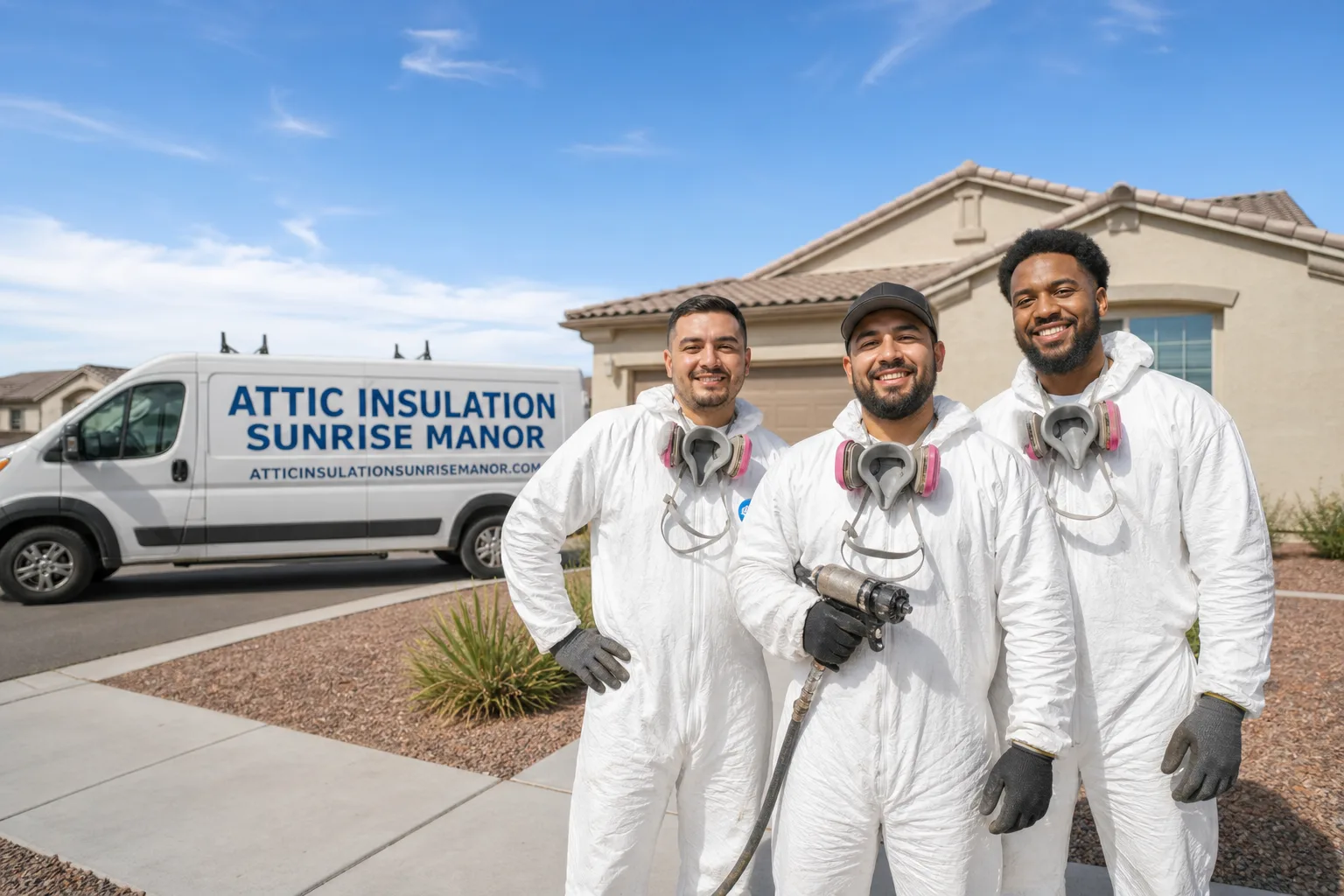
Trusted Spray Foam Insulation for Sunrise Manor Homeowners
Spray foam insulation in Sunrise Manor solves a problem that batt insulation can’t: it seals the gaps where desert heat pushes into your attic and wall cavities. Sunrise Manor sits in the middle of the Mojave, where summer highs regularly climb past 110°F, and every crack in your building envelope lets that heat inside. If your rooms never cool evenly or your power bill keeps climbing, the insulation is usually the reason. Our technicians have up to 11 years of experience with closed-cell and open-cell foam systems from Icynene and Demilec, and we test-fit the material to your actual attic and wall conditions before recommending anything. We carry both spray foam and blown-in because no single method works for every home in Sunrise Manor. For a free estimate, call (844) 320-9312.
Closed Cell Spray Foam Insulation
Closed Cell Spray Foam Insulation is the dense, rigid foam that cures hard and adds both a thermal barrier and structural stiffness to the space it fills. It’s the right call when you need maximum R-value per inch, when there’s a moisture risk to block, or when your wall cavities are thin and you can’t afford to give up depth. In Sunrise Manor’s dry desert climate, closed-cell foam also handles the sharp temperature swing between a blazing afternoon and a cool winter night without sagging or shrinking. Our team installs Icynene and Demilec closed-cell systems, sprayed to the thickness your home needs. Typical spray foam insulation jobs in Sunrise Manor run $2,500 – $8,000 depending on square footage and thickness, and the written estimate sets the final price.
Where Closed-Cell Foam Performs Best
Rim joists, exterior wall cavities, and any surface that faces the outside air are jobs where closed-cell foam earns its cost. The hard cure blocks air movement and vapor in one pass, so you’re not layering a separate air barrier on top. If your home has a crawlspace under living space, closed-cell foam is usually the material we recommend there too.
What the Hard Cure Actually Does
The foam expands, bonds to the framing, then sets rigid with a smooth outer skin. That rigidity adds a small measure of racking strength to the wall assembly, and it means the foam won’t slump over a couple of decades the way some loose-fill materials can. It also means the surface can be left exposed in a lot of attic applications without a separate covering.
Open Cell Spray Foam
Open Cell Spray Foam is the softer, lower-density foam that expands roughly a hundred times its liquid volume and cures with an airy feel. It’s a good match for interior walls and attic rooflines where you want air sealing and sound control more than you want a rigid structural layer. Because open-cell foam stays vapor-permeable, it suits assemblies where moisture needs to move through rather than get trapped. In Sunrise Manor homes, we often use it on the underside of roof decks where the attic is being brought inside the conditioned space. We install GreenFiber and Rockwool products alongside our open-cell systems when a blended approach makes sense. Expect typical spray foam work to land in the $2,500 – $8,000 range, with the written estimate fixing the exact figure.
A Sound Choice for Living Areas
The open structure of the foam absorbs sound well, so shared walls, media rooms, and bedroom partitions quiet down noticeably. If you live near a busy road in Sunrise Manor, the acoustic gain can matter as much as the thermal gain.
Filling Irregular Cavities
Open-cell foam expands into odd-shaped bays, around plumbing penetrations, and behind electrical boxes where batts would leave gaps. Those gaps are usually where the heat finds its way in, so filling them is the whole point.
Spray Foam Insulation Contractors
Spray Foam Insulation Contractors bring equipment you can’t rent at a hardware store: proportioners, heated hose lines, and the training to mix two-part chemicals safely at the right temperature and ratio. That’s why foam is one of the few insulation materials that genuinely requires a trained installer. A bad mix cures improperly, off-gasses, or fails to bond, and you usually find out years later. We work from eight manufacturer brands, including Owens Corning, Johns Manville, Knauf, and Rockwool, so the product gets matched to your home rather than to whatever a single-product contractor happens to carry. Typical spray foam projects in Sunrise Manor cost $2,500 – $8,000 depending on the area covered and the foam type, and the free estimate nails down the number before anyone lifts a hose.
Why the Ratio Matters
Foam chemistry is unforgiving: the two components have to hit the mixing chamber at the right temperature and pressure or the cells come out wrong. Our technicians have up to 11 years of experience running this equipment, and they monitor the spray pattern as they go. Curing foam also releases heat, which is why light coats on thick pours is safer than one heavy pass.
Vetting the Installer
The local professional we connect you with is licensed and insured as their state requires, so ask to see those documents before the job starts. It’s also fair to ask which foam brand they’ll use and whether they’ve sprayed in a desert climate before. Sunrise Manor’s summer attic temperatures punish installers who don’t account for them.
Spray Foam Attic Insulation
Spray Foam Attic Insulation is the single biggest energy upgrade most Sunrise Manor homes can make, because the attic is where heat builds up and pushes back down through the ceiling. In an unconditioned attic, foam sprayed on the underside of the roof deck turns that space into a conditioned zone, which brings your ductwork and air handler inside the thermal envelope. That one change typically fixes the hot-bedroom, cold-living-room problem that plagues ranch homes across the valley. We also offer a simpler approach: seal the attic floor and insulate the ceiling plane, which sits at the lower end of the range. A typical spray foam attic job in Sunrise Manor costs $2,500 – $8,000, and the written estimate sets the final price.
Conditioned vs. Vented Attic
Choosing between an encapsulated attic and a vented one depends on your roof assembly and duct location. Conditioning the attic gains comfort and duct efficiency; staying vented costs less and keeps the roof deck cooler. We walk you through both during the estimate.
Solar Heat and Deck Temperature
A roof in full summer sun in Sunrise Manor bakes the shingles and radiates heat down. Foam on the underside of the deck resists that migration far better than batts pinned to the ceiling joists. It also keeps the deck surface from reaching the extreme limits that shorten shingle life.
Spray Foam Wall Insulation
Spray Foam Wall Insulation fills the cavities between studs from the outside, or from the inside during a remodel, and gives you a continuous barrier where batts tend to sag and gap. If your home was built before energy codes improved, the walls are likely under-insulated and the gaps around outlets, plumbing, and window frames leak air all summer. Open-cell foam is the usual choice for interior walls, while closed-cell goes on exterior walls for the higher R-value per inch. Wall insulation in Sunrise Manor typically runs $1,500 – $5,000 depending on wall area and foam type. The estimate is free and the written price is the one you pay.
Drilling and Refilling Finished Walls
For finished homes, we drill small holes between studs, inject the foam, then patch and refinish when the scope includes it. It’s invasive but far cheaper than gutting a room. We’ll tell you honestly whether the wall area justifies the disruption.
Blocking Thermal Bridging
Wood studs conduct heat through the wall even when the cavity is full, which is why continuous insulation matters. Foam coats the side of each stud it touches, so the bridging effect shrinks compared with a batt-filled cavity. The improvement shows up as fewer hot spots on interior wall surfaces.
Rim Joist Spray Foam
Rim Joist Spray Foam seals the band of framing at the top of your foundation, the spot where the floor structure meets the exterior wall. That rim area is one of the biggest air leaks in a house, often accounting for a large share of winter heat loss and summer heat gain in a Sunrise Manor home. If your floors feel cold in January or your baseboards sweat in a heat wave, the rim is worth inspecting. We spray closed-cell foam into the rim cavity, which seals the gap and adds insulation in one step. Because it’s a small area, the free estimate usually folds rim joist work into a larger attic or crawlspace project rather than pricing it alone.
Symptoms of a Leaky Rim
Cold floors near exterior walls, dust streaks where air blows in, and ice or condensation on the sill plate are all signals to look at the rim. So is a draft you can feel with a hand near the floor line. The gap behind the rim board is often open clear to the outside air.
Why Closed-Cell Belongs Here
The rim joist sits at the boundary between indoor and outdoor conditions, and moisture can collect there. Closed-cell foam’s vapor-blocking cure protects the wood better than open-cell foam or fiberglass batts, which can trap damp against the joist and create rot.
Crawl Space Spray Foam Insulation
Crawl Space Spray Foam Insulation seals the underside of your home and can convert a vented crawlspace into a sealed, conditioned one, which helps with both comfort and moisture control. In Sunrise Manor, crawlspaces are less common than slab foundations, but where they exist they’re a major source of air leakage into the home above. A sealed crawlspace also keeps dust, insects, and outside air from moving up through your floors. We typically apply closed-cell foam to the walls and rim, sometimes capping it with a vapor barrier. Spray foam work on a crawlspace usually falls in the $2,500 – $8,000 range, with the written estimate setting the figure.
Sealed vs. Vented Crawlspaces
A vented crawlspace in a hot, dry climate can still draw in hot air from outside, and that air carries radiant heat with it. Sealing the space removes the stack effect that pulls air up into the house. It also keeps the subfloor structure cooler and less likely to warp.
Moisture and Pest Control
The hard surface of closed-cell foam doesn’t give insects or rodents much to tunnel through, so it’s a mild deterrent compared with batts. It also blocks the humid exterior air from condensing on cold framing. Any existing moisture problem gets addressed before we spray, never after.
Garage Spray Foam Insulation
Garage Spray Foam Insulation is worth considering for any Sunrise Manor home where the garage shares walls or ceiling with living space. An attached garage is often the biggest unsealed area in the house, and heat from a sun-baked garage pulls straight through the shared wall into your bedrooms or kitchen. Foam on the garage ceiling and the shared wall stops that transfer, and it also moderates the garage’s temperature if you use it as a workshop. We apply closed-cell foam to the shared wall and open-cell foam where the ceiling needs to stay breathable. Garage insulation typically runs within the $2,500 – $8,000 spray foam range, and the estimate is free.
The Shared Wall
Code requires a fire-rated separation between an attached garage and the house, and that wall is where most heat passes through. Foam on the house side of the wall improves both the thermal separation and the air separation. Keeping the garage out of the conditioned zone is the whole goal.
Door and Ceiling Gaps
The top and bottom of the garage door leak heavily, and the ceiling above the garage is often bare. Foam on the ceiling plane plus weatherstripping at the door moves the garage several degrees closer to the outside. That’s a modest gain but a real one for anyone using the space.
Brands We Service
We install spray foam from Icynene and Demilec, two of the leading producers of open- and closed-cell foam systems. We know where each brand’s product behaves best, how it cures under Sunrise Manor’s summer heat, and what thickness it needs to hit your target R-value. Our work isn’t limited to foam, either. We carry Owens Corning and Johns Manville fiberglass, Knauf batts, Rockwool mineral wool for fire and sound resistance, CertainTeed products, and GreenFiber cellulose blown-in.
Many homeowners want to know whether we can handle a specific brand. The answer is usually yes: we’ve sprayed or blown insulation from all eight of those manufacturers, and our technicians have up to 11 years of experience matching each one to the space. Whether you have Icynene, Demilec, Rockwool, or any other make, we can help. The right product for your attic, not the easiest one to install, is how we work.
Signs You Need a Pro Right Now
- Power bills that keep climbing. If your summer bill jumps every year without a rate increase, the insulation is usually the culprit. A thermal camera run during the estimate can pinpoint where the heat is getting in.
- Rooms that never feel even. A hot bedroom over the garage, a freezing hallway, or a kitchen that’s always warmer than the living room usually means air leaks in the attic or walls. Foam sealing fixes the draft, not just the thermal gap.
- Visible gaps, sagging, or bare joists. If you can see daylight in the attic, or batts have slumped away from the framing, the insulation is no longer doing its job. Even a small gap can cost real money over a season.
- Condensation or damp framing. Water on the sills, rust on the ductwork, or dark stains on attic rafters point to a moisture problem that foam can help manage when applied correctly. Call us to look before it spreads.
- A previous job that underdelivered. If insulation was installed a few years ago and the house still feels wrong, the material may be the wrong type or was poorly sealed. We diagnose what went wrong before recommending a fix.
Our Process, Step by Step
- 1
Free estimate visit. We measure the attic and wall areas, look for gaps and leaks, and check the current insulation type and depth. We bring a thermal camera to show you exactly where heat is moving. The written estimate comes from those measurements, not from a phone call guess.
- 2
Material recommendation. You get a plain explanation of which product fits your home and why: closed-cell for moisture-heavy spots, open-cell for interior walls, or a combo of spray foam and blown-in. We’ll cover the tradeoffs between brands and foam types, and you can ask anything.
- 3
Scheduling and preparation. We book the install day, tell you how to clear the space, and confirm which areas need to be vacated. Crews dispatch 7am to 7pm, Sunday through Friday.
- 4
The install. Technicians mask and protect surfaces, spray in calculated passes to the right thickness, and monitor curing temperatures throughout. We check depth and coverage as we go, so the job meets the specification in the estimate.
- 5
Walkthrough and follow-up. We walk you through what was done, show you the finished work, and leave you with a record of the materials used. If anything looks off after the job, you call us and we take a look.
How Much Does Spray Foam Insulation Cost in Sunrise Manor?
A typical spray foam insulation job in Sunrise Manor runs $2,500 – $8,000, and the final number depends on which areas are sprayed, whether you choose open-cell or closed-cell foam, and how thick the foam needs to be. A straightforward attic floor seal with open-cell foam lands toward the lower end, while a whole-house project with closed-cell foam in the walls, rim joists, and roofline sits near the top. A spray foam attic job on its own usually runs $2,500 – $4,500, and a full-house combo that includes wall insulation ends up in the $5,000 – $8,000 range.
Several factors move the price. Square footage is the biggest lever: a large ranch home has more attic area to cover. Foam type matters, since closed-cell costs more per board foot than open-cell because of its density and higher R-value per inch. Access also counts. A tight attic with limited headroom or a crawlspace entry can slow the install and add labor.
You avoid overpaying by getting a written estimate that spells out the foam type, the thickness, and the square footage. If one contractor quotes a number and won’t break down what’s included, ask. A fair estimate names the brand, the R-value target, and whether prep work like masking and cleanup is in the price.
The free estimate from our team includes a walkthrough, thermal imaging, and a written price before any commitment. Call (844) 320-9312 to schedule yours.
Our Service Area Near Sunrise Manor
We schedule spray foam insulation across Sunrise Manor and the surrounding east valley. That includes North Las Vegas, Whitney, Winchester, and neighborhoods within a short drive. We also work in Las Vegas, Paradise, Henderson, Spring Valley, and Enterprise. Farther out, we cover Summerlin, Boulder City, and Sandy Valley. If you’re comparing options with attic insulation or a blown-in approach, our team can walk you through how each plays against your home and the local climate before you commit.
Serving Sunrise Manor, NV – Our Local Coverage Area
We serve Sunrise Manor and nearby communities. Use the map below to see the area we cover. If you’re nearby, we can almost certainly help.
Frequently Asked Questions About Spray Foam Insulation in Sunrise Manor
Spray foam insulation is a two-part chemical that’s sprayed onto a surface and expands to fill gaps, cavities, and irregular spaces. It cures into either a hard, dense foam (closed-cell) or a soft, airy foam (open-cell), depending on the formula. Both types seal air leaks and add thermal resistance in one application, which is why foam outperforms batts in leak-prone assemblies.
Most residential spray foam jobs take one day, and larger whole-house projects can stretch to two. A single attic with straight access typically goes fastest. Wall cavities drilled from the outside, crawlspaces, and multiple areas add time. Your written estimate will state the install day and expected duration before work begins.
Most spray foam jobs in Sunrise Manor cost between $2,500 and $8,000, depending on the areas sprayed, foam type, and thickness. Walkthrough estimates bring the number down to a single written price. Call (844) 320-9312 for an exact quote. Estimates are free.
Yes. We install Icynene and Demilec spray foam systems, which cover both open-cell and closed-cell lines. Those two brands give us the range to handle moisture-heavy rim joists and sound-sensitive interior walls in the same project. We also install insulation from Owens Corning, Knauf, Rockwool, and GreenFiber. Our technicians have up to 11 years of experience with these materials.
Same-day service is available for some jobs. We answer 24/7. Fast dispatch from 7am to 7pm, Sunday through Friday. A call outside dispatch hours gets booked into the next opening. Spray foam is a scheduled install after a free estimate visit, and most projects are booked once the scope and written price are confirmed.
Manufacturer warranties on the foam itself come from the brand, and installation workmanship coverage is set by the local pro in the written estimate. Ask for both documents before signing. The warranty terms should name what’s covered, how long, and what conditions trigger a claim. Reading that before the install is the best protection.
Clear the attic access path and move anything stored in the work area before the crew arrives. Expect masking and protection on nearby surfaces, and plan to stay out of the work zone during the install and the curing period. The exact prep checklist is confirmed when the install day is booked.
Schedule Your Spray Foam Insulation Service in Sunrise Manor Today
Spray foam is a decades-long decision, so the free estimate is worth your time. Our team walks the attic and walls, runs a thermal camera, and writes a clear price before you commit. Call (844) 320-9312. We answer 24/7. Fast dispatch from 7am to 7pm, Sunday through Friday. Your estimate comes with no obligation.
Written by the team at Attic Insulation Sunrise Manor.